What is inside the Red Fort?
Chhatta Chowk, the covered bazaar
The first thing inside is a vaulted arcade of shops, and most people treat it as a corridor to get through. Look up instead. The vaulting is the point, and it is the only stretch of the fort where you are walking through a roofed street rather than across open ground. The stalls sell what stalls sell; nobody needs to buy anything here.
The Naubat Khana, which everyone walks past
Beyond the bazaar stands the drum house, where music was played to announce arrivals. It reads as a gateway now and the crowd flows straight through it towards the open lawn, which is a pity, because it is the hinge between the public fort and the courtly one. This is the first place a guide earns the fee: without one it is a building you cross under.
Diwan-i-Am, where the crowd bunches
The public audience hall is the big one, a wide colonnade of scalloped red arcades opening on to the lawn, and it is where every group photograph in Delhi seems to get taken. Come at opening time and you get it nearly clear for twenty minutes. By eleven there are three tour groups in it and you are waiting for gaps.
The marble along the east wall
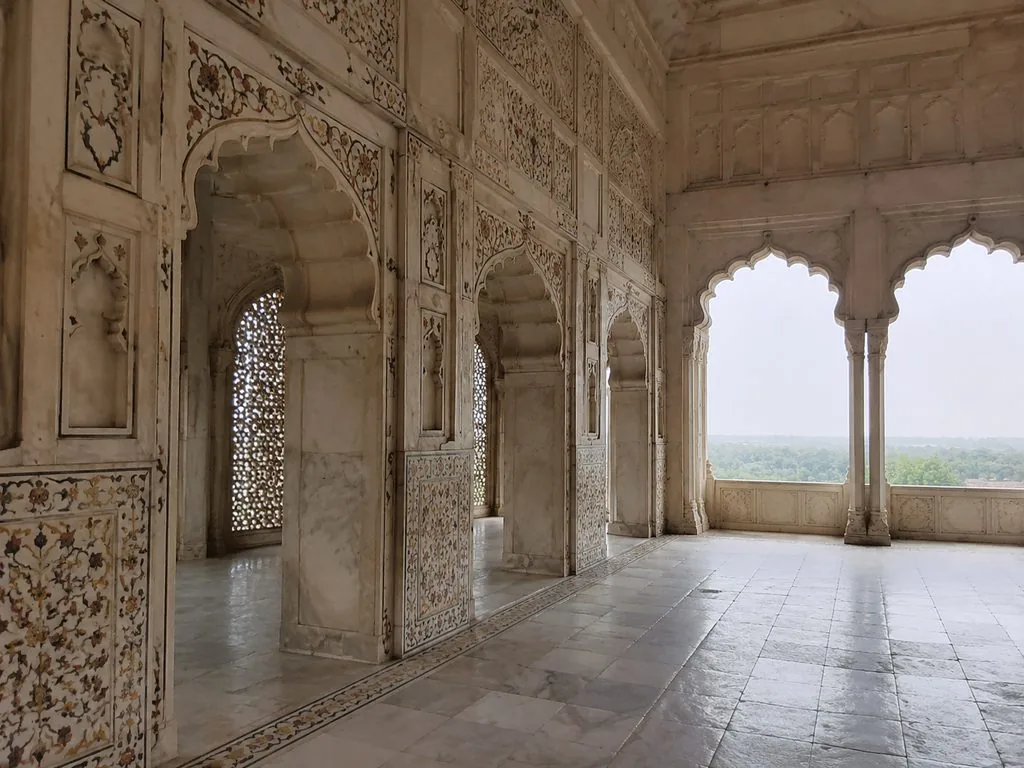
Past the lawn the material changes. The Diwan-i-Khas, the Khas Mahal and the Rang Mahal stand in a line along the eastern side in white marble, which is why the question of whether the fort is sandstone or marble has an annoying answer. It is both, and the two materials do different jobs: sandstone for the walls the city sees, marble for the rooms the emperor used. That split is the subject of why it is called the Red Fort.
The Moti Masjid, the gardens and the museums
The Pearl Mosque and the gardens sit beyond the palaces, and this is where visitors thin out, because by then the legs have had enough. It is the quietest part of the fort and worth the extra fifteen minutes. The museums occupy barracks buildings, which are themselves a piece of the history: after 1857 the British cleared much of the interior and garrisoned it, so the sparse feel of the grounds is a nineteenth-century decision rather than a Mughal one. The Archaeological Survey of India sells a composite ticket that adds the museums for roughly ₹5 or ₹50 more depending on which gate rate you pay. The longer story is on the fort’s history.
What works
- A clear one-way walk, so it is hard to miss the main buildings
- The Diwan-i-Am is nearly empty for the first twenty minutes after opening
- Marble palaces and sandstone walls in a single enclosure
- The mosque and gardens at the far end are the calmest part of the site
Worth knowing
- Interiors are open shells; almost nothing is furnished
- Labels are thin, so buildings blur together without a guide
- The Naubat Khana gets treated as a doorway and skipped
- Long open stretches between buildings, with no shade in the middle of them
Walk the whole length to the far wall first, then work back through the palaces. You get the quiet end while it is cool and hit the Diwan-i-Am on the way out, when the group photographs have moved on somewhere else.
The cheapest way to have it explained
The guide-only listing meets at the Lahori Gate and starts from $5, and that from-price buys the guiding alone — the entry ticket, a rickshaw, hotel pickup and the Jama Masjid or Chandni Chowk extensions are all add-ons you choose at booking, so nobody should read $5 as admission included. It runs about an hour and a half to two and a half hours in English or Hindi, rated 4.6 across 51 reviews, and the guide makes contact on WhatsApp beforehand. Sebastian from Germany left the review that describes what it is for: “Excellent tour guide. I learned a lot about this place.”
Frequently asked questions
What is inside the Red Fort in Delhi?
A covered bazaar, a drum house, the Diwan-i-Am public audience hall, a row of white marble palaces along the east wall, the Moti Masjid, gardens and museums in the barracks buildings. Walked in that order it takes two to three hours — see how long to spend.
Which gate do visitors enter by?
Visitors go in on the Lahori Gate side, the great west gate facing Chandni Chowk, which is also the ramparts the Prime Minister speaks from on 15 August. Getting to it is covered on how to get there.
What should I not miss at the Red Fort?
The Naubat Khana, because almost everyone treats it as a doorway, and the Moti Masjid and gardens at the far end, because most people turn back before them. Both are quiet and both are part of the same walk.
Is the Red Fort empty inside?
The buildings are largely open shells rather than furnished rooms, and the grounds are sparser than the walls suggest. That is a consequence of the clearances after 1857 — the history explains it.