The Red Fort, explained

The fort is closed every Monday, and it has two gate prices: the ASI lists entry at about ₹35 for Indian citizens and about ₹600 for foreign visitors — roughly seventeen times apart, and the difference decides what is worth buying. If you pay the citizen rate, the only thing the tours on this site can honestly sell you is the guiding (the two prices, in full). If you pay the foreign rate, a guided skip-the-line product costs only a little more than the gate plus the queue (the six compared). Either way, go in the morning, allow two to three hours, and spend the afternoon across the road in Chandni Chowk.
The Red Fort, or Lal Qila, is the walled palace-fortress that the Mughal emperor Shah Jahan built in the 1600s as the centre of his new capital Shahjahanabad, it stands at the top of Old Delhi with its west gate facing the length of Chandni Chowk, it has been a UNESCO World Heritage Site since 2007, and it is closed every Monday of the year.
I am Arjun Mehta. I grew up in Daryaganj, fifteen minutes on foot from the Lahori Gate, and I spent two college summers working there as a licensed guide before I took an office job I mostly like. I still walk relatives round the place several times a year. So I know which halls people crowd into, which ones they stride past, and what the queue looks like at noon in June.
Why the fort sits where it does
Shah Jahan built a capital here, and Chandni Chowk is the road out of his front door. It runs west from the Lahori Gate in a straight line, and for nearly four centuries the fort has been the thing at the end of it. So put them in the same day: the fort in the morning while it is cool, the market in the afternoon when it is at its best anyway.
Two prices, and which one is yours
Here is the thing that makes this fort unusual, and the reason this site sorts you before it sells you anything. The Archaeological Survey of India charges Indian citizens one rate and foreign tourists another, and the second is something like seventeen times the first. Children under fifteen go free either way.
If you are Indian, every product on this page costs several times your entry ticket. I am not going to dress that up. Buy your ticket at the gate or online from the ASI, and if you spend anything here, spend it on the guiding alone. The fort is badly signposted, the labels are thin, and half of what makes the place extraordinary is invisible unless somebody tells you it is there. Admission is worth buying once.
If you hold a foreign passport, the arithmetic inverts. Your gate rate is already several times the Indian one, so a guided visit with the queue handled is a small premium on a ticket you were buying anyway. The cheapest listing here is guide-only, and I will keep saying so: the entry ticket on that one is an add-on you tick at booking, along with the rickshaw and the hotel pickup. If you would rather not think about it, take the option with the ticket already inside the price.
Monday, and the rest of the calendar
The fort is shut every Monday of the year. It opens Tuesday to Sunday, roughly half past nine in the morning until half past four in the afternoon, with last entry a little before closing and the usual seasonal drift at both ends. The evening sound and light show is a separate ticket bought at the fort, it starts earlier in the winter months, and it is dark on Mondays as well. I have watched families arrive on a Monday with a driver waiting and a train to catch. Check the day before you book the driver.
The walk, in the order the fort gives you
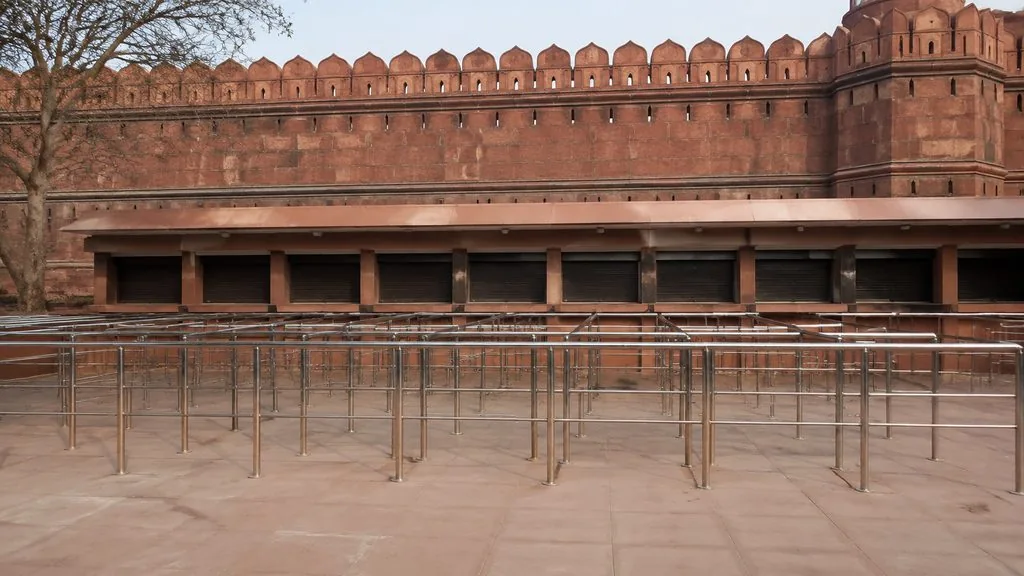
You go in on the Lahori Gate side. Immediately inside is the Chhatta Chowk, a covered bazaar with a vaulted roof that was the court’s own market and is now the coolest few minutes of a summer visit. Then the Naubat Khana, the drum house, where musicians announced arrivals and where anyone below a certain rank got down off their elephant. Then the Diwan-i-Am, the hall of public audience, with its scalloped red arcades — the room where petitions were heard, and the building a good guide transforms most.
Past that, the marble palaces run along the east wall, which once looked out over the river: Diwan-i-Khas, Khas Mahal, Rang Mahal. This is where people work out that the Red Fort is red on the outside and white within, so if you have been arguing about sandstone or marble, you were both right. Then the Moti Masjid and the gardens, which feel thin because the British cleared much of the courtly interior after 1857 and put barracks where the buildings had stood. Those barracks hold the museums now, and almost nobody goes in.
What to wear, which is less than you think
The fort enforces no dress code. Shorts are fine. Nobody at the gate is inspecting hemlines, and I would like that sentence to travel, because the internet has convinced a lot of visitors otherwise. The one place it matters is the mosque areas, where shoulders and knees should be covered. Everything else is a heat problem rather than a modesty problem: the enclosure is large and shadeless in long stretches, so light full-length clothing, a hat, water and sunscreen will do more for your morning than any wardrobe rule.
What I actually tell relatives
Go at opening time. The first hour is worth two of any hour after noon, the light on the sandstone is better, and the security queue has not built yet. Give the fort two hours, three if you want the museums, ninety minutes if you are moving with purpose and only want the headline buildings. Come by metro: Lal Quila station is a couple of minutes from the gate and a car will spend longer than you think looking for somewhere to stop. Then walk out of the Lahori Gate and straight into Chandni Chowk for the afternoon, and eat something.
That is the whole plan. If you are Indian, the guide is the only part I would argue for. If you are not, take the version with the ticket in it and stop optimising. Either way, do not turn up on a Monday.
So what do I actually book?
If you are an Indian citizen: the gate or ASI online ticket, and nothing else — unless the stories matter to you, in which case a guide at the gate is money well spent and the guided options are ranked honestly. If you are visiting from abroad: the skip-the-line guided ticket is the straightforward buy, and the worth-it question gets a real answer rather than a pitch.
Frequently asked questions
Is the Red Fort open every day?
No. It is closed every Monday, and open roughly 9:30 to 4:30 the rest of the week, with last entry before closing. The evening sound and light show also skips Mondays. Hours and the Monday closure.
Do I need a guide for the Red Fort?
Need, no. But the fort is badly signposted and its best stories are invisible without one — the Diwan-i-Am, the marble palaces and the 1857 clearances all read as plain buildings until somebody explains what happened in them. When a guide earns it, and what you are looking at.
How long does the Red Fort take?
Two to three hours for a fair visit; ninety minutes covers the headline buildings if you keep moving. Mornings are cooler and quieter. Time budgets in detail.